

The Panchayat Showdown
The stage was set. The village panchayat trial was the closest thing to a courtroom drama you could find in a rural Indian village. Picture this: my dad, standing alone, accused of stealing land, building illegally, and causing all kinds of imagined misdeeds. Surrounding him were villagers—each with their own agendas, all eager to see us fall.
The panchayat leaders sat at the center, their faces stern, as if they were overseeing a trial of national importance. On one side, the southeast neighbour, puffed up with rage, knowing his illegal quarrying plans were shattered because of us. On the other, a group of villagers angry about the crisscrossing road, now cut off. The neighbour to the east, fuming over his lost claim, stood there with a sense of false entitlement. And, of course, the contractors we fired, egging the crowd on like some twisted cheerleaders.
I imagine my dad, standing there after heart surgery, probably wondering, "How did I get here?"
Meanwhile, I sat thousands of miles away in the UK, staring at land maps, sending rapid-fire messages, hoping the facts would somehow override the villagers’ blind anger. I had done my homework. We had the land records, the maps, the proof that everything we were doing was within legal rights. But would that matter in this chaotic village trial?
My dad finally got his chance to speak. He stood before the panchayat and calmly presented the case:
1. The official land map showed that the legal road ran along our northern boundary, not through the middle of our farm.
2. The land in the southeast corner was ours, and the boundary markers proved it.
3. The neighbour who stirred up all the trouble? He wasn’t even the legal owner of the land he had been farming. It belonged to his father-in-law’s father, who had passed away years ago, and no one had legally transferred ownership.
4. We had already voluntarily given up part of our eastern border to our neighbour after we purchased the land and the official survey confirmed it didn’t belong to us. The neighbour who benefitted from this didn’t even know it was his land until the official marking.
The facts were undeniable. And when my dad revealed the maps—official government documents, mind you—the panchayat leaders went silent.
The southeast neighbour’s face turned redder than the local chilli peppers. The villagers started whispering among themselves. For all their shouting and accusations, they hadn’t expected cold, hard proof to show up at their little trial.
The panchayat leaders, seeing the evidence, made their ruling. All the baseless accusations were dismissed, one by one. And then, the final blow came—a ruling that not only settled our case but sent a shockwave through the village. The panchayat declared that no villager could access government land for farming purposes anymore. Not just our small piece of land near the house—but all government land in the area. Twenty-four acres, gone. All of it fenced up, with access allowed only for grazing cattle.
That meant the majority of villagers who had been tilling government land without authorisation but purely on first-come basis for years now had nothing. If they wanted to keep farming, they would need to go through the same legal process we were undergoing to acquire it.
The mood in the trial shifted. The angry mob that had stormed our farm hours ago now slunk away quietly, like a group of school kids caught cheating on a test. Their ringleader, our southeast neighbour, who had been so determined to see us fall, was now the cause of their collective loss. He had not only lost the land he had been farming on illegally, but he had also triggered a ruling that affected many other villagers who had been doing the same. The tables had turned. The neighbour to the east, who had shouted about us stealing his land, suddenly had nothing left to say. And the original contractors we fired? Nowhere to be seen.
Victory, as they say, was sweet—but it was also surreal. We had won the case, but it wasn’t just about the house or the fencing. We had essentially reshaped the entire village’s farming landscape, whether we intended to or not.
We didn’t waste any time. The very next morning, we resumed fencing our land. With the panchayat’s ruling in hand, there was no one to stop us now. The neighbours, once so eager to argue, now kept their distance. Even the southeast neighbour, the man who had started the whole mess, stayed far away, nursing his wounded pride.
Within a week, the fencing was done. The land was secure. And just like that, the seeds of our farm were planted—literally.
But here’s where the humour sneaks in. Because for all the drama and chaos, we still had that celebration lunch planned. Yes, the same one I mentioned before—the one that had nothing to do with the fencing or the villagers but everything to do with the planting of dragon fruit saplings. It was a gathering of family, where we invited relatives for a pooja and offerings to bless the new beginnings.
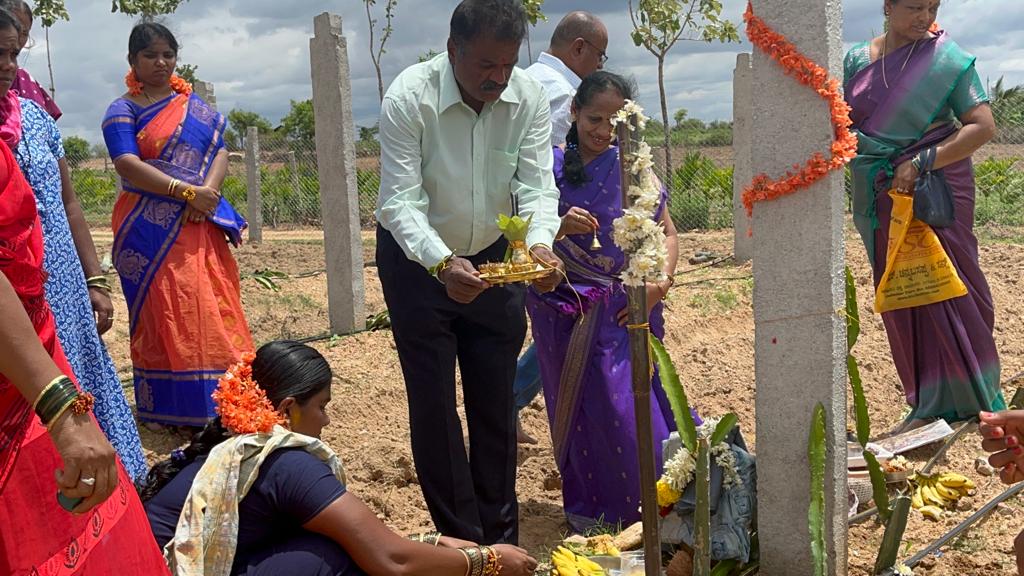
Pooja offering by my parents at the time of plantation ceremony
In a bizarre twist of events, the same villagers who had shouted at us just days earlier were now attending our celebration lunch. We invited everyone—including those who had yelled at us, called us goondas, and accused us of stealing land.
Why, you ask? Well, it’s simple. We had won the battle, but we didn’t want to carry animosity with us into the future. Yes, we knew that not everyone at the lunch was our well-wisher. Some probably sat there with a smile on their face but resentment in their hearts. But we didn’t care. The goal was to start on a clean slate, legally and socially. The villagers sat there, eating quietly. I’d like to think a few of them realized the error of their ways, maybe even respected the fact that we had followed the legal process to the letter. Others, well, they probably just came for the free food. And that’s the thing about village life. It’s a complex web of relationships, where enemies one day can be lunch guests the next. You see, when you buy a piece of land in a strange village, you’re not just buying soil and rocks; you’re buying the attention of every villager with a loud opinion and a long memory. Especially when that village lies in the heart of India. Here, suspicion is the default, and trust is earned slowly—one chai at a time, if you’re lucky. In this case, we had skipped the tea and jumped straight to building, and that rubbed some people the wrong way. I don’t know if we made any friends that day, but at least we hadn’t made any permanent enemies.
The celebration lunch marked the end of a long, stressful chapter. The farm was now officially ours, secured by fencing, law, and a lot of perseverance.
But this story wasn’t quite over. Oh no, there were more twists and turns to come—more surprises that neither my father nor I could have predicted.
And that, my friends, is where we’ll pick up in the next series of posts.
Until then, this is your Deepak signing off!